

Hunt West Complete Plan Dashboard
Everything you need for your tag applications and hunting plans.
HUNTER SNAPSHOT
-
CLIENT NAME
TRAVIS HUGHES
-
WEAPON OF CHOICE
RIFLE
-
VEHICLE
1992 4WD 4RUNNER
-
LODGING
TRUCK BASECAMP
-
TERRAIN
MODERATE
-
HUNTING METHOD
GLASSING/STILL HUNTING
YOUR 3RD SEASON MULE DEER HUNT
GMU 501 | South Park Herd
OVERVIEW:
Quality Colorado Late Season Mule Deer Hunt
Big Country, Multiple Hunt Styles
Excellent Genetics, Moderate Deer Densities
Big Burns, & Timber Canyons
3-Year Average Success: ~47% (High)
Population: 2,660 (Moderate)
Buck Ratio: 26:100 (Moderate-High)
Deer Tag Holders: 80 (Elk Hunters = Low)
Regs: Any Antlered Deer | Nov. 7–Nov 15, 2026
YOUR HUNT PLAN
Operating rules
Spend at least 2-3 hours in an area, but if you do not find does, keep moving.
A full rotation of zones is about 7–9 days.
Snowstorms reset deer movement, so take that into consideration after weather changes.
Keep camp mobile so you can stay on-time.
Daylight for hunting is limited. Make sure you are hiking in and out in the dark.
If storms roll through, be on the glassing knob when they break.
Build fires on glassing knobs to stay out longer (they warm you twice).
Track deer in the snow if the tracks are less than 24-hours old.
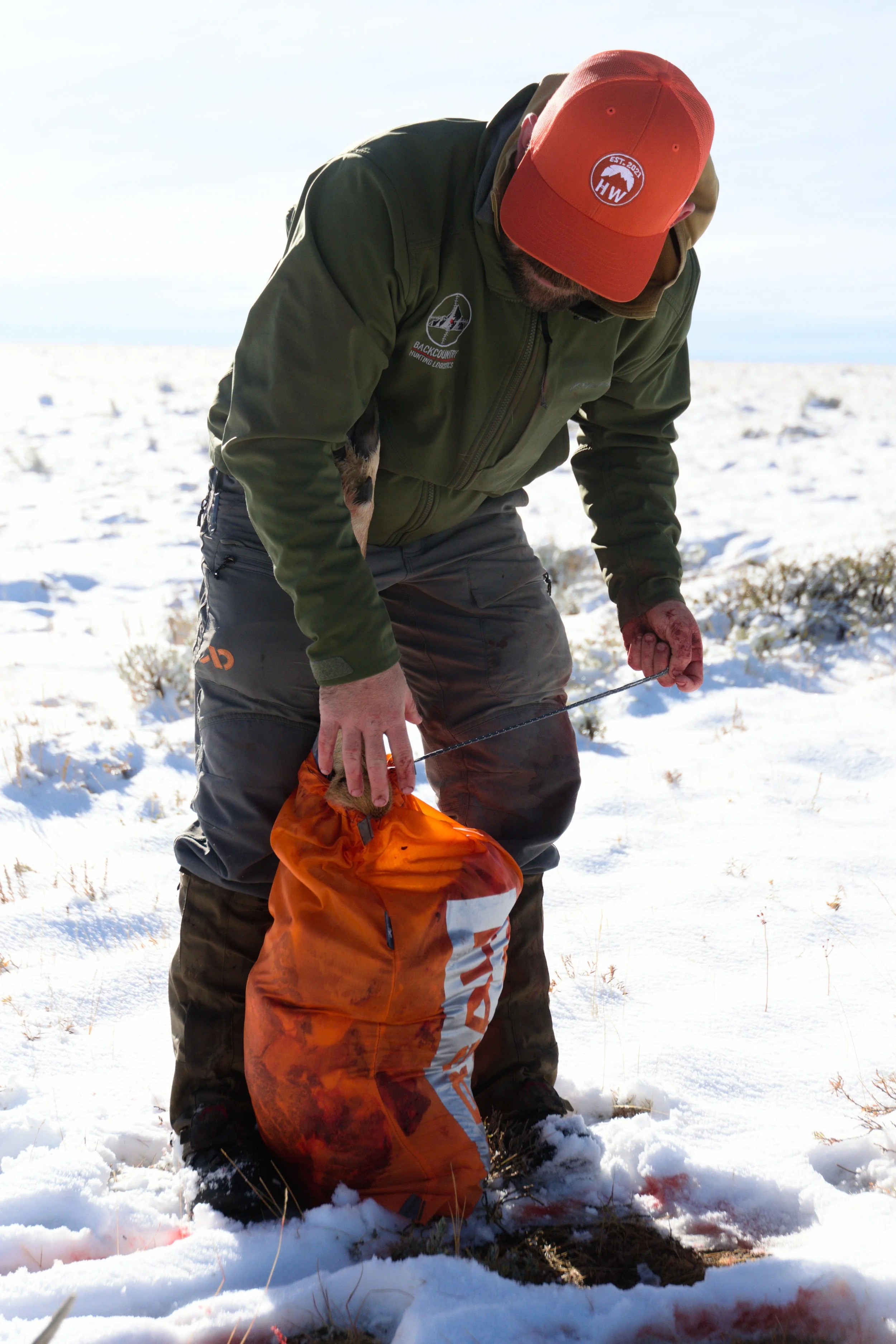
BUTCHERING TIPS
-
First, slow down. After the excitement of the shot and recovery, this is when hunters get careless with knives, terrain, and heavy loads.
Confirm the deer is dead from a safe distance.
Unload or safely secure your weapon.
Take photographs before moving the animal.
Attach or validate your tag as required.
Check your state’s rules concerning evidence of sex, edible-meat requirements, and carcass transportation—especially in CWD areas.
Send your location and status through your satellite communicator if you are alone.
Before cutting, study your surroundings. If the deer is lying on a steep slope, move or anchor it before beginning. A deer sliding downhill while you have a knife in your hand is a rodeo nobody asked for.
-
Carry:
Two sharp knives or one knife with replaceable blades
Lightweight sharpener or extra blades
Four or five breathable game bags
Nitrile gloves
Paracord
Contractor bag or clean ground sheet
Headlamp with spare batteries
First-aid supplies
Snacks/Electrolytes
Pack with a capable meat shelf
Optional lightweight pulley or mechanical-advantage system
Plastic contractor bags are useful as a clean working surface, but meat should not remain sealed inside them. Warm meat needs airflow.
-
Skin the First Side
Pinch the hide along the backbone and make a shallow cut from the base of the skull toward the tail.
Do not plunge the knife downward. Keep the blade nearly parallel with the hide so you do not cut into the meat or body cavity.
From that centerline cut:
Skin down across the shoulder.
Skin down across the ribs.
Skin over the hindquarter.
Continue until the upper side is fully exposed.
Use your free hand to pull the hide while making short strokes with the knife. Let tension do most of the work.
Keep hair on the hide side and meat on the meat side. Every time you reach across the hide with dirty gloves, sleeves, or a knife, you move hair and grime onto the meat.
-
Remove the Front Quarter
A deer’s front quarter is attached by muscle, not bone.
Pull the front leg away from the body and cut through the natural seam behind the shoulder blade. Continue underneath the shoulder until the entire quarter comes free.
Place it immediately into a breathable game bag. If practical, hang it from a tree or place it on clean rocks, logs, or brush where air can circulate around it.
Do not set a warm quarter directly on snow for an extended period. Snow can insulate the meat, wet the game bag, and cool only the exterior.
-
Pull the hind leg outward and begin cutting along the inside of the thigh.
Follow the seam toward the ball-and-socket joint. Rotate the leg until you locate the joint, then sever the connective tissue around it. You should not need to saw through the femur or pelvis.
Continue cutting around the outside of the quarter until it comes free.
If your state requires evidence of sex to remain naturally attached, plan for that before completely removing the appropriate hindquarter. Regulations vary, so know the requirement before the hunt—not while standing over a dead buck in the dark.
Place the hindquarter in its own game bag and get air around it.
-
The backstrap runs alongside the spine from the shoulder toward the pelvis.
Make one cut along the spine and another along the upper edge of the ribs. Use the tip of the knife to peel the meat away from the bone in long strokes.
Work carefully around the shoulder blade and pelvis. Put the backstrap into a smaller game bag rather than tossing it loose into a quarter bag.
Trim all usable meat from:
The neck
The brisket
The outside of the ribs
Between the ribs, where required or practical
The area around the shoulder blade
The pelvis
Any remaining accessible muscle
This is where “quartering” becomes “butchering.” The four quarters are obvious. The smaller pieces are where hunters either recover the whole animal or leave several pounds behind.
-
The tenderloin sits inside the body cavity, beneath the spine and just ahead of the pelvis.
With the gutless method, reach it from the rear of the rib cage:
Carefully cut behind the last rib.
Create only enough room to reach inside.
Keep the stomach and intestines pressed away from the blade.
Locate the tenderloin against the underside of the spine.
Work it free with your fingers and short knife strokes.
Avoid puncturing the paunch. If that happens, move contaminated meat away from the spill immediately and clean the affected area with clean water and cloth—not dirt, grass, or pine needles.
When in doubt, remove the guts of the animal to get these out.
-
Turn the Deer Over
Before rolling the deer, organize everything from the completed side.
Make sure:
Every game bag is closed.
Meat is positioned away from the carcass.
Your knife is sheathed.
Your rifle or bow is out of the way.
Nothing will roll downhill.
Roll the deer onto its processed side, using the remaining hide as a clean surface beneath it. Repeat the entire sequence:
Skin the second side.
Remove the front quarter.
Remove the hindquarter.
Remove the backstrap.
Trim the neck, ribs, brisket, and pelvis.
Recover the second tenderloin.
-
Deal With the Head and Cape
If you are keeping the head, antlers, or cape, remove them only after the meat is secured.
For a shoulder mount, skin well behind the shoulder and leave plenty of cape for the taxidermist. When in doubt, leave more hide—not less.
In a CWD management area, transporting the brain or spinal column may be restricted. Know whether the skull must be cleaned or the head submitted for testing before leaving the unit.
The head and cape should generally be your last priority. Meat comes first.
GEAR CHECKLIST
-
OPTICS
BINOCULARS
BINOCULAR HARNESS
TRIPOD
TRIPOD ADAPTER
SPOTTING SCOPE
DIGISCOPING ADAPTER
LENS CLOTH
-
WEAPON
RIFLE
AMMUNITION
RANGEFINDER
BIPOD / SHOOTING REST
REAR SHOOTING BAG
RIFLE SLING
SCOPE COVERS
CLEANING KIT
-
DAY HUNT GEAR
BACKPACK
FIRE STARTER
HEADLAMP / SPARE BATTERIES
GPS / ONX DEVICE
WATER BOTTLES / BLADDER
LUNCH & SNACKS
FIRST-AID KIT / TOILET PAPER
TREKKING POLES
-
CLOTHING
HUNTER’S ORANGE
INSULATED BOOTS
GAITERS
WOOL SOCKS
BASE LAYERS
MID LAYERS
INSULATED / PUFFY JACKET
WATERPROOF OUTER LAYERS
-
CLOTHING (CONT.)
HUNTING PANTS
BEANIE
BALL CAP
LIGHT GLOVES
INSULATED GLOVES/MITTENS
NECK GAITER
HAND WARMERS/HAND GAITER
SUNGLASSES
-
MEAT CARE
GAME BAGS
KNIFE
REPLACEABLE BLADES / SHARPENER
NITRILE GLOVES
PARACORD
CONTRACTOR BAGS
COOLERS
ICE / FROZEN WATER JUGS
-
VEHICLE
TOW STRAP
TIRE CHAINS
SHOVEL / TRACTION BOARDS
FLAT-REPAIR KIT
JUMPER CABLES / JUMP PACK
EXTRA GAS
TOOL KIT
EXTRA FOOD, WATER & CLOTHING
-
CAMP GEAR
SPARE WATER
FOOD SUPPLIES
PAPER TOWELS
FOLDABLE CHAIR
TENT
SLEEPING BAG & PAD
DEVICE CHARGERS
PROPANE STOVE
-
PERSONAL ITEMS
HUNTING LICENSES / CARCASS TAGS
HUNTER-ED CARD
ORANGE VEST
ORANGE HAT
PRESCRIPTION MEDICATIONS
SUNSCREEN / LIP BALM
EAR PROTECTION
SATELLITE COMMUNICATOR
HIGH HARVEST RECOMMENDATION:
GMU 50/500/501 (DM-050-O3-R)
The Kenosha mountains late season, third season deer hunt is a great combination of having high country for warm November hunting and plenty of low ground to chase deer on. In the event you get a lot of weather, it's not going to demand somebody backpack in, and there's a wide variety of places where you can hunt in rhoded areas, wilderness areas, or behind private ground. The hunter success is very high, meaning there's good access to the deer that are there. The next step in verifying this hunt would be to take a wildlife drive early in the morning and take a look at the amount of deer that are available to see from the roads on the winter range before February hits. You will likely need to fill the gaps in drawing for both deer and elk after your first hunts here with 2nd choice tags, though the random odds will help in 2028.
2025 Draw Odds: 100% at 4 Pts
Season Dates: Nov. 7–Nov 15, 2026 (Any Buck)
3-Year Harvest Percentage: ~67%
COLORADO MULE DEER

EASY DRAW REC (FUTURE YEARS)
GMU 46/39 (D-M-039-O3-R)
This unit is predominantly timbered with higher-elevation public lands, and private land dominating the low elevations on the east. It’s close to home, which is a bonus for learning the unit easily. The harvest success is not as high here as the above recommendation, but it is still very good with nearly half of the hunters finding bucks to take home. Previous Hunt West clients have found both deer and elk to hunt in this unit, and often not far from the main highways that serve as arteries to the high country. Choose this unit knowing you will leave points on the table, but want a hunt close to home to learn for deer and elk long into the future.
2025 Draw Odds: 100% at 1 Pt
3rd Season: Nov. 7–Nov 15, 2026 (Any Buck)
3-Year Harvest Percentage: ~47%
APPLICATION SESSION REPLAY
Password: Huntwest2026